


How are bicycle accident cases evaluated differently from car accident claims in New Jersey?
Bicycle accident cases in New Jersey differ from typical car accident claims primarily because cyclists are afforded the same rights and responsibilities as vehicle drivers. Evaluating a bicycle accident involves analyzing traffic rules, right-of-way, lane positioning, and signaling, similar to car accidents. However, these cases often involve more severe injury profiles due to the lack of protective structures like steel frames, airbags, or seatbelts for cyclists. The insurance analysis can also be more complex in bicycle cases.
How do right-of-way rules differ for cyclists and drivers at intersections and shared roadways?
In New Jersey, a cyclist lawfully riding on the road is considered traffic, so right-of-way rules at intersections are similar for both cyclists and drivers. Vehicles already in the intersection have priority, and drivers must yield to traffic, including cyclists, coming from the right or when making left turns. However, cyclists are not treated like pedestrians under crosswalk laws, so whether a cyclist is walking or riding through a crossing can significantly affect right-of-way determinations.
What are common bicycle accident scenarios and how is fault determined?
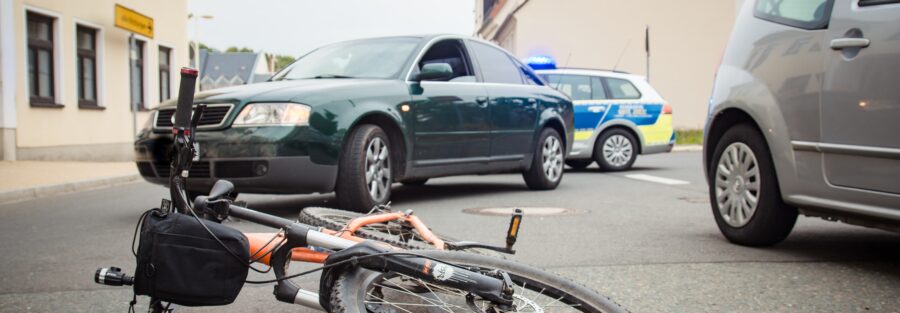
Common bicycle accident scenarios include intersection and driveway crashes, right hook collisions, left turn crashes, and overtaking incidents where a vehicle passes too closely. Fault is usually determined by assessing right-of-way, the last safe observation made, whether the driver signaled and waited to turn safely, and if the cyclist followed traffic rules. Timing, sight lines, speed, and adherence to traffic laws are critical factors in these cases.
How does shared responsibility affect the outcome of a bicycle accident case in New Jersey?
Under New Jersey’s comparative negligence law, a jury assigns fault percentages totaling 100%. If a cyclist is 50% or less at fault, they can still recover damages, but the award is reduced by their fault percentage. If the cyclist is more than 50% at fault, they cannot recover damages, as recovery is completely barred.
Why do bicycle accident cases often involve more severe injuries and how does that impact case evaluation?
Bicycle accidents often result in more severe injuries due to the cyclist’s exposure, lacking protective structures like vehicle occupants have. Common injuries include fractures, head trauma, and significant scarring. These cases require early evaluation of medical records, imaging, rehabilitation needs, future medical treatments, lost earnings, and long-term functional impacts, which all influence case building and valuation.
What challenges arise in gathering evidence for bicycle accident cases compared to vehicle collisions?
Evidence in bicycle accident cases is harder to preserve because the injured cyclist may be unable to document the scene, identify witnesses, or give statements. Bicycles are often moved quickly, and nearby cameras may overwrite footage. Key evidence such as signal timing, traffic flow, and skid marks is often fleeting, especially at intersections or driveways, making timely evidence gathering crucial.
How do insurance issues play out in bicycle accident cases, particularly without a traditional auto-policy?
Insurance plays a central role in bicycle accident cases due to New Jersey’s no-fault system. Personal injury protection (PIP) in auto policies covers cyclists for medical expenses. If a cyclist lacks auto insurance, coverage can be sought through New Jersey’s PLEGA program, which provides benefits for uninsured individuals. Understanding available insurance is essential, as auto insurance often covers medical expenses in bicycle accidents.
What factors make bicycle accident cases more complex legally and practically?
Bicycle accident cases are complex due to multiple legal frameworks, including traffic law compliance and insurance considerations like no-fault and underinsured motorist coverage. Serious injuries necessitate evaluating permanency and future impact on the cyclist’s life. Determining comparative negligence and available insurance coverage are additional challenges affecting the case’s outcome.
What influences the resolution of bicycle accident cases as they progress?
The resolution of bicycle accident cases depends on four key factors: liability clarity, comparative negligence exposure, injury documentation, and available insurance coverage. Clear liability and documented injuries increase the likelihood of resolution, whereas uncertain liability and minimal damages decrease it. Recent New Jersey rulings have highlighted distinctions for e-bike riders, excluding them from personal injury protection coverage, adding complexity to these cases.